

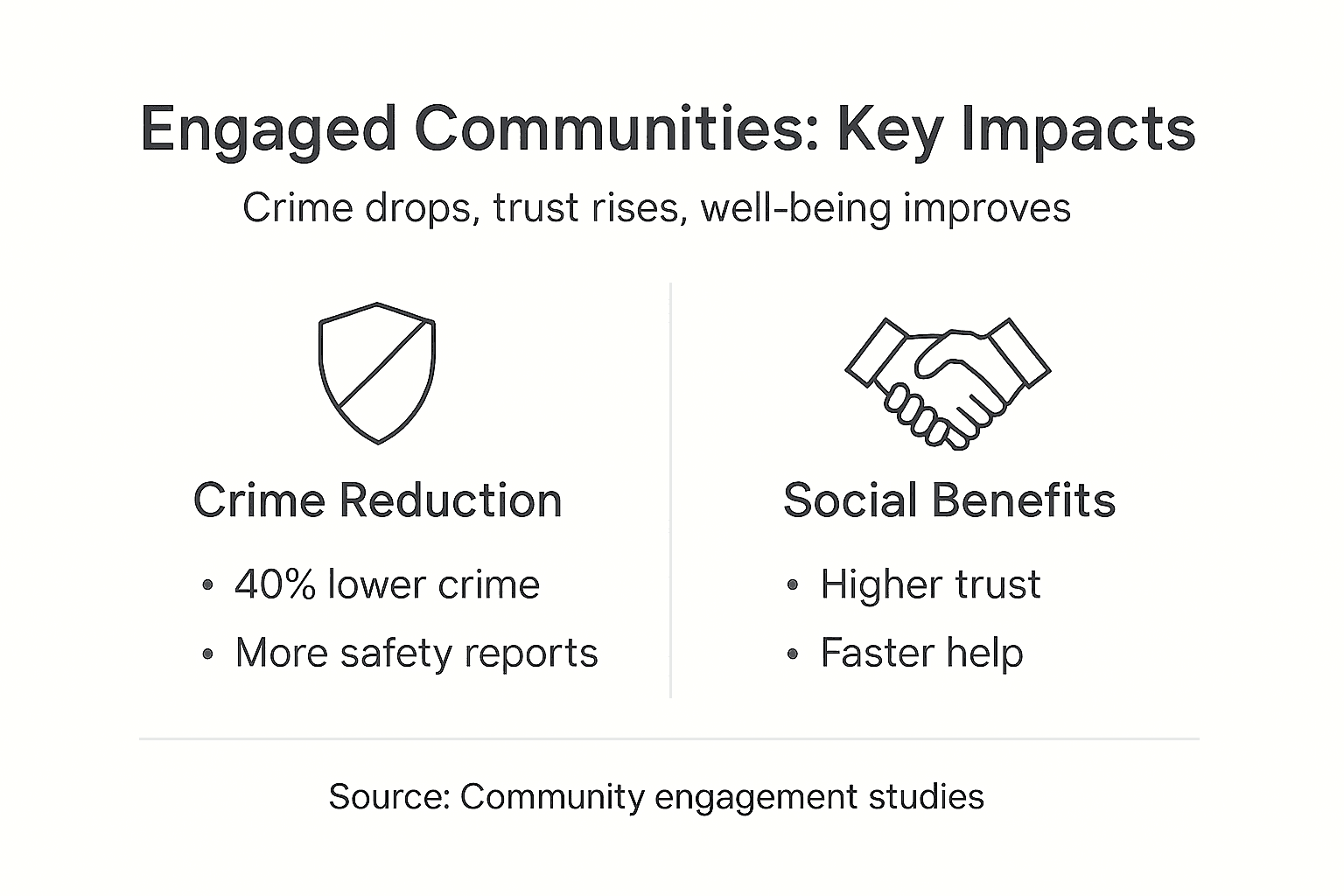
Active community engagement can reduce local crime rates by up to 40% through enhanced informal social control and neighborly vigilance. Engaged neighborhoods build mutual trust and resilience, creating safer environments where residents look out for one another. This guide teaches you how to foster sustained community connections that strengthen your local area, improve well-being, and create lasting positive change in your neighborhood.
Table of Contents
- Understanding the Importance of Community Engagement
- Mechanisms That Drive Community Engagement Benefits
- Common Misconceptions About Community Engagement
- Frameworks and Metrics for Sustaining Engagement
- Practical Steps to Build and Foster an Engaged Community
- Conclusion: The Lasting Value of Engaged Communities
- Discover How Town Wall Empowers Your Community
- Frequently Asked Questions
Key Takeaways
| Point | Details |
|---|---|
| Crime Reduction | Engaged communities reduce crime rates by nearly 40% while improving resident well-being and safety. |
| Trust Mechanisms | Strong information flow, privacy protections, and active participation build neighborhood trust. |
| Common Myths | Effective engagement doesn't require fancy technology or personal identity disclosure. |
| Practical Frameworks | Use moderation, privacy tools, and sustained participation to maintain engagement. |
| Action Steps | Adopt privacy-friendly platforms and organize trust-building activities for concrete results. |
Understanding the Importance of Community Engagement
Engaged communities lower local crime through informal social control and vigilance. When neighbors know and trust each other, they naturally watch out for suspicious activity and intervene before problems escalate. This community engagement reduces crime rates significantly compared to disconnected neighborhoods.
Trust among neighbors enables quicker problem solving and mutual aid. Residents in engaged communities share resources during emergencies, help elderly neighbors with daily tasks, and coordinate responses to local challenges. This collective action strengthens the entire neighborhood fabric.
Engaged communities recover faster from disturbances and disruptions. Whether facing natural disasters, economic downturns, or social tensions, neighborhoods with strong connections bounce back more effectively than isolated areas. The social capital built through engagement provides a buffer against adversity.
Benefits include enhanced safety, well-being, and stronger local identity. Consider these key advantages:
- Reduced fear of crime and increased sense of security
- Improved mental health through social connection
- Better information sharing about local issues
- Stronger collective identity and neighborhood pride
- Enhanced property values from safer, more desirable areas
The local community platform Town Wall demonstrates how digital tools can support these real-world connections. By providing a space for neighbors to share updates and engage anonymously, platforms enable the trust and information flow that make communities thrive.
Pro Tip: Start small with one block or street before expanding. Building trust takes time, and focusing your initial efforts creates a strong foundation for broader engagement.
Mechanisms That Drive Community Engagement Benefits
Trust builds willingness to collaborate and support neighbors. When residents believe their neighbors will reciprocate help and act in good faith, they're more likely to participate in collective activities. This mutual trust creates a virtuous cycle where each positive interaction strengthens future cooperation.
Open information flow combats misinformation and rumors. Communities where residents share accurate, timely information experience fewer panic-driven reactions and better decision-making. Transparent communication channels help residents separate fact from fiction, especially during crises or rapid change.
Participation correlates with improved individual mental well-being. Research consistently shows that socially connected individuals report better mental health outcomes. Engaging with your community provides purpose, reduces isolation, and creates supportive relationships that buffer against stress.
Privacy-preserving participation encourages honest contributions. When residents can share concerns or ask questions without fear of judgment or exposure, more voices join the conversation. Anonymous participation lowers barriers for discussing sensitive topics like safety concerns or personal struggles.
Community involvement creates social capital and resilience. The networks, norms, and trust developed through engagement become valuable assets during both routine and extraordinary circumstances. These invisible bonds hold communities together when external pressures mount.
Key mechanisms driving these benefits include:
- Repeated positive interactions building familiarity and trust
- Shared spaces (physical and digital) facilitating connection
- Community norms encouraging reciprocity and mutual support
- Information channels distributing knowledge quickly
- Moderation systems maintaining respectful dialogue
The Town Wall platform's privacy and engagement features exemplify how design choices can enhance these mechanisms. By protecting user privacy while enabling robust conversation, platforms can amplify the social dynamics that make communities strong.
Pro Tip: Focus on facilitating connections rather than controlling them. The best community builders create conditions for organic relationship development, not rigid structures that feel forced.
Common Misconceptions About Community Engagement
Engagement benefits all residents by building social capital, not just leaders. Many people assume community involvement only serves organizers or activists, but everyone gains from safer streets, better information, and stronger social networks. Even passive participants who read updates without posting benefit from increased awareness and connection.
Simple, well-moderated tools outperform fancy tech for most communities. Neighborhoods don't need elaborate apps or expensive platforms to engage effectively. A basic bulletin board system with good moderation beats a feature-rich platform that confuses users or creates barriers to participation. Focus on accessibility and ease of use.
Anonymity and privacy increase participation without reducing trust. This surprises many who believe transparency requires full identity disclosure. However, privacy-focused community engagement shows that protecting personal information actually encourages more honest, diverse contributions. Trust comes from consistent, respectful behavior, not knowing someone's full name.
Misconceptions discourage newcomers and create unnecessary barriers. Address these common myths directly:
- Myth: You need tech-savvy residents to succeed. Reality: Simple tools work for all ages and skill levels.
- Myth: Engagement requires huge time commitments. Reality: Even small, regular contributions build community.
- Myth: Anonymous posting enables trolling and abuse. Reality: Good moderation handles bad actors regardless of anonymity.
- Myth: Only extroverts can lead community efforts. Reality: Quiet organizers often excel at facilitating inclusive spaces.
- Myth: Engagement works only in wealthy areas. Reality: All neighborhoods benefit from connection and trust.
Pro Tip: When introducing community engagement initiatives, address these misconceptions upfront. Clear communication about expectations and benefits increases participation from skeptical residents.
Frameworks and Metrics for Sustaining Engagement
Effective engagement balances participation, trust, and transparent info exchange. These three pillars work together to create healthy community dynamics. Too much focus on one element at the expense of others creates imbalance and unsustainable patterns.
Ten key metrics help you assess community health and engagement:
- Participation rate (percentage of residents actively engaging)
- Response time to local issues or concerns
- Crime statistics compared to baseline
- Resident satisfaction surveys and feedback
- Event attendance and volunteer numbers
- Information accuracy and misinformation incidents
- Diversity of voices and perspectives represented
- Mental well-being indicators from community surveys
- Trust levels measured through periodic assessments
- Sustained activity over time (not just initial enthusiasm)
Impact typically becomes measurable after minimum six months of sustained activity. Quick wins matter for momentum, but real transformation takes consistent effort over multiple seasons. Plan for this timeline when setting expectations and evaluating progress.
Combine qualitative feedback with quantitative data for full assessment. Numbers tell part of the story, but resident testimonials and observations reveal nuances that metrics miss. Interview long-time residents about changes they've noticed and capture their stories.
The following framework compares different engagement approaches:
| Approach | Strengths | Limitations | Best For |
|---|---|---|---|
| In-person meetings | Deep discussion, relationship building | Time-intensive, excludes busy residents | Policy decisions, complex issues |
| Digital platforms | Convenient, anonymous options, broad reach | Requires internet access, tech comfort | Daily updates, quick coordination |
| Hybrid model | Combines benefits of both approaches | Requires managing multiple channels | Most diverse communities |
| Event-based | Creates memorable shared experiences | Episodic rather than ongoing | Building initial connections |
Helps communities adapt strategies based on metrics and resident input. Regular review of your chosen metrics reveals what's working and what needs adjustment. Stay flexible and willing to experiment with different approaches based on feedback.
Practical Steps to Build and Foster an Engaged Community
Establish privacy-respecting community platforms to lower participation barriers. Choose tools that don't require extensive personal information or complex registration processes. The privacy-focused platform Town Wall demonstrates how minimal data collection encourages broader participation while maintaining security.
Organize trust-building activities like neighbor introductions and local events. Simple gatherings like block parties, community clean-ups, or informal coffee meet-ups create opportunities for face-to-face connection. These interactions complement digital engagement and build relationships that carry over to online spaces.

Implement community moderation to manage misinformation and foster respect. Designate trusted residents to review flagged content and enforce community guidelines. Effective moderation maintains a welcoming environment where diverse perspectives can coexist without descending into conflict or abuse.
Encourage anonymous posting for sensitive topics to increase inclusivity. Some residents hesitate to discuss concerns about safety, health, or personal struggles under their real names. Anonymous options let these voices contribute without fear of judgment or consequences.
Monitor engagement regularly and adapt strategies as needed. Track your chosen metrics monthly and solicit resident feedback quarterly. Be willing to change approaches that aren't working rather than doubling down on ineffective strategies.
Leverage simple tools before considering complex tech solutions. Start with basic communication channels and add features only as clear needs emerge. Many communities overinvest in sophisticated platforms when simpler options would serve better.
Practical action steps include:
- Set up a neighborhood communication channel (digital or physical)
- Recruit 3-5 initial moderators from diverse backgrounds
- Host a launch event to introduce the platform and build excitement
- Post regular updates to model active participation
- Respond promptly to resident questions and concerns
- Share positive stories and celebrate community wins
- Address conflicts quickly and fairly using clear guidelines
- Survey residents quarterly about their experience and needs
Pro Tip: Make the first 30 days count by posting daily updates and responding to every comment. This early activity sets norms for engagement and shows residents the platform is actively monitored.
Conclusion: The Lasting Value of Engaged Communities
Engaged communities lower crime and improve mental well-being for all residents. The evidence clearly shows that neighborhoods where people know and support each other experience better outcomes across safety, health, and quality of life measures. These benefits compound over time as trust deepens and connections multiply.
Trust and effective communication underpin community strength. Without reliable information flow and mutual confidence among neighbors, even well-intentioned initiatives struggle. Investing in these foundations pays dividends through smoother problem-solving and more resilient social networks.
Sustained, inclusive engagement builds enduring neighborhood vitality. One-off events or short-term campaigns create temporary energy, but lasting change requires ongoing participation from diverse residents. Make engagement a permanent part of your community culture, not a temporary project.
Everyone's participation benefits the shared local environment. You don't need to be an extrovert or natural leader to contribute meaningfully. Every question asked, concern shared, or neighbor helped strengthens the collective fabric. Your involvement matters more than you might think.
Discover How Town Wall Empowers Your Community
Building an engaged community becomes easier with the right tools. The Town Wall platform offers privacy-first features that support neighborhood connection without compromising resident security. Unlike social media giants that harvest personal data, Town Wall collects only usernames and passwords, letting you participate without surveillance.

The platform supports anonymous participation to boost trust and inclusivity, making it safe for residents to discuss sensitive issues or ask questions without fear. Built-in community engagement tools help moderators manage content and reduce misinformation while keeping conversations productive and respectful.
Designed for all demographics in your neighborhood, Town Wall's simple interface works for both tech-savvy millennials and residents who prefer straightforward communication. This secure neighborhood communication helps build safer, more resilient communities by facilitating the trust and information flow that research shows reduces crime and improves well-being.
Frequently Asked Questions
What are the key benefits of building an engaged community?
Engaged communities experience significant crime reduction, with studies showing decreases of up to 40% through enhanced informal social control. Beyond safety, residents report improved mental well-being from social connection and mutual support networks. These communities also demonstrate greater resilience during crises, recovering faster from disruptions because of established trust and communication channels.
How does anonymity impact community participation?
Anonymity lowers participation barriers significantly for sensitive topics like safety concerns or personal struggles. Residents who might hesitate to speak publicly under their real names contribute more freely when anonymous options exist. This increases honest feedback and brings diverse voices into community conversations that might otherwise remain silent. Privacy-focused platforms like Town Wall demonstrate how protecting identity actually strengthens rather than weakens community trust.
What role do community moderators play?
Moderators reduce misinformation by reviewing flagged content and enforcing community guidelines consistently. They help sustain trust by addressing conflicts quickly and maintaining respectful dialogue even during disagreements. Effective moderators balance free expression with community standards, creating spaces where diverse perspectives can coexist productively.
Do I need advanced technology to build an engaged community?
Simple, well-moderated communication channels usually suffice for most neighborhoods. Fancy features and complex platforms often create more barriers than benefits, especially for less tech-savvy residents. Focus on building relationships and trust through accessible tools rather than investing in gadgets that complicate participation.
How can we measure the success of our community engagement?
Use metrics like participation rates, safety statistics, and resident satisfaction surveys to track progress quantitatively. Combine these numbers with qualitative stories from residents about changes they've noticed in neighborhood dynamics. Expect to see measurable impact after at least six months of sustained effort, and review your chosen metrics monthly to adapt strategies based on what the data reveals.